
Fetching...
Fetching...

22 July 2025
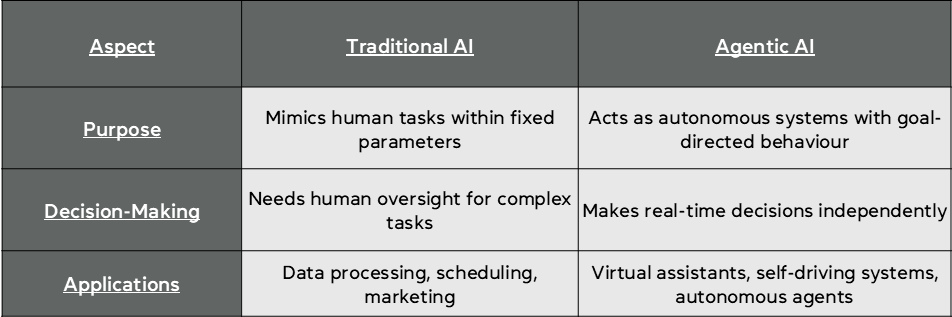
Agentic AI refers to a class of artificial intelligence that can act independently or on behalf of a system or human. Unlike traditional AI systems that operate within predefined boundaries, Agentic AI can assess its environment, plan multi-step actions, execute decisions, and adapt on the fly—all without human intervention.
AI’s evolution began in the 1950s with Turing’s idea of machine intelligence, followed by ELIZA in 1966—the first chatbot. The 1970s and ’80s saw rule-based expert systems like MYCIN and early reinforcement learning breakthroughs. In the 2000s, machine learning gained momentum, with IBM Watson demonstrating real-world reasoning. The 2010s brought deep learning and generative pre-trained transformer (GPT) models, enabling advanced language understanding. By the mid-2020s, Agentic AI emerged—autonomous, adaptable systems capable of decision-making, long-term planning, and collaboration with minimal human oversight.1
Think of it as an intelligent virtual agent navigating the real world: observing, reasoning, acting, and learning as it goes.
In this blog, we explore what Agentic AI is, its key capabilities, real-world applications, future outlook and more.
Autonomy and Intelligent Decision-Making: Agentic AI can operate independently, making context-aware decisions without step-by-step human input. Powered by advanced algorithms and Large Language Models (LLMs), it interprets complex data, simulates human judgment, and navigates multi-step workflows aligned with specific goals.
Natural Language Processing (NLP), Enhanced Efficiency and Productivity: By taking over time-consuming, decision-intensive tasks, agentic AI allows human teams to focus on strategic initiatives and creative problem-solving. This boosts overall organizational output and frees up talent for high-value activities. Agentic AI uses contextual cues and natural language to communicate seamlessly with humans. It understands intent, adapts to changing situations, and manages complex tasks through intuitive, human-like interaction.
Human-AI Collaboration and Adaptability: Agentic AI doesn’t replace humans—it augments them. By integrating into existing workflows and tools, it enhances human decision-making, reduces cognitive load, and enables smarter, faster outcomes across teams. With built-in feedback loops and exposure to real-world data, agentic AI improves over time. It adapts dynamically to new environments, learns from outcomes, and refines its behaviour without the need for manual retraining.
Enterprise System Integration: Seamless connectivity with ERP, CRM, and other enterprise platforms allows agentic AI to work within existing ecosystems. This interoperability ensures smooth data flow and enables automation of end-to-end business processes.
Agentic AI is already finding applications across industries, streamlining operations, enhancing decision-making, and powering autonomous systems in fields like healthcare, finance, and logistics:
Insurance: End-to-End Claims Automation - Agentic AI is revolutionizing the insurance industry by streamlining the entire claims process—from filing to final payout. It enables instant validation, gathers data from multiple sources, and communicates empathetically with customers. By automating routine tasks, it reduces processing time, minimizes human error, and frees adjusters to focus on complex cases, enhancing both efficiency and customer experience.
Logistics & Supply Chain: Intelligent Optimization - In logistics, where timing is critical, agentic AI agents dynamically analyse real-time data to optimize delivery routes, predict bottlenecks, and adjust inventory based on demand. This results in reduced delays, better resource allocation, and enhanced customer satisfaction, enabling businesses to respond faster and more efficiently to shifting market conditions.
Finance: Risk Intelligence & Personalized Planning - Agentic AI empowers the financial sector with real-time market analysis, risk detection, and investment strategy development. It helps advisors shift focus from data-heavy tasks to relationship-building and strategic planning. These agents continuously monitor risks, ensure compliance, and offer personalized financial planning, enhancing both decision-making and resilience across financial institutions.
Healthcare & Pharma: Smarter Care and Drug Discovery - Agentic AI is transforming healthcare by recommending personalized treatment plans and assisting with diagnostics based on patient data. It also accelerates drug discovery by identifying potential targets and predicting compound efficacy from massive datasets—reducing costs and time to market while improving patient outcomes and care delivery.
Customer Service: 24/7 Personalized & Proactive Support - AI-powered virtual agents deliver always-on customer support, capable of resolving complex, multi-step queries. These agents interpret context, predict needs, and offer hyper-personalized responses across channels. From billing resolution to product recommendations, agentic AI ensures seamless, proactive customer experiences that drive satisfaction and brand loyalty.
Cybersecurity: Real-Time Threat Detection & Response - Agentic AI strengthens IT operations by continuously monitoring systems for anomalies. It identifies threats such as phishing attacks, automatically blocks malicious content, and alerts teams. This adaptive security approach reduces risk and relieves teams from constant manual monitoring.
Enterprise Integration & Cloud Scalability - Agentic AI thrives by integrating with enterprise tools like CRM, ERP, and HR systems—breaking down silos and enabling cross-functional automation. Cloud platforms like AWS and Azure provide the compute power and data access these agents need, while automation suites like UiPath simplify development, deployment, and management of AI-driven workflows.
The trajectory of Agentic AI is both promising and profound, signaling a shift toward more autonomous, intelligent systems across industries:
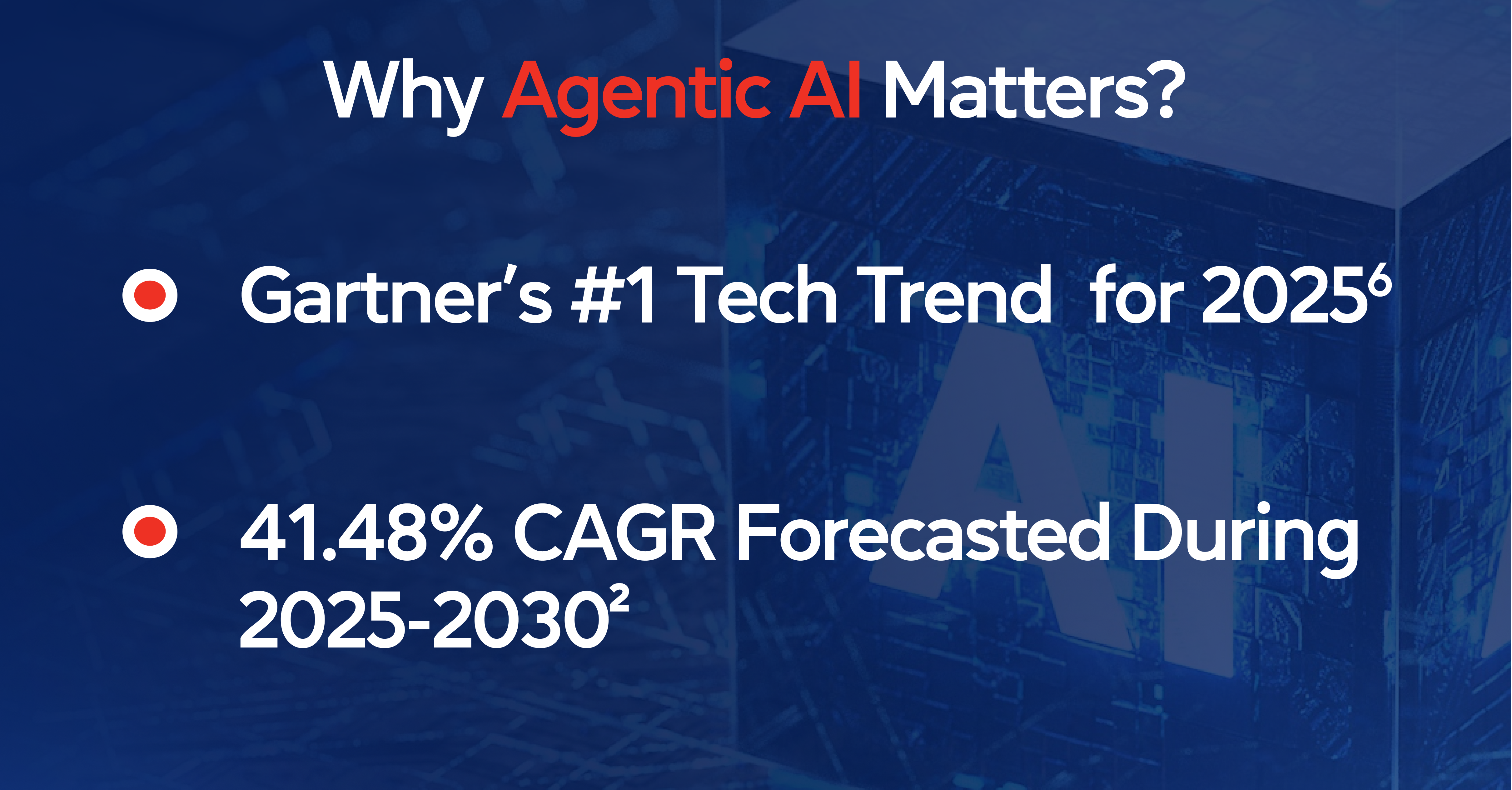
• The global Agentic AI market size is projected to grow from $7.28 billion in 2025 to $41.32 billion by 2030, at a CAGR of 41.48% during the forecast period (2025-2030).2
• Gartner predicts that at least 15% of day-to-day work decisions will be made autonomously through agentic AI by 2028, up from 0% in 2024.3
• 33% of enterprise software applications will feature agentic AI by 2028, up from less than 1% in 2024.3
• 51% of enterprises are exploring AI agents; with another 37% are already piloting them.4
• AI agents can reduce customer service costs by 30% and fraud activity by 40%.4
• A report by Accenture claims that healthcare industry can save up to $50 billion annually using agentic AI.5
Agentic AI is not just an evolution of existing AI technologies—it’s a paradigm shift. As machines become agents with memory, goals, and learning capabilities, they will reshape industries, redefine customer experiences, and reimagine what it means to "work."
The age of passive AI is ending. The age of Agentic AI has just begun.
1. World Wide Technology 2. Mordor Intelligence 3. Gartner 4. Wisdom Tree 5. Accelirate 6. Gartner