
Fetching...
Fetching...

16 June 2025
The Digital India Mission, launched by the Government of India under the motto "Power to Empower," has redefined the country's development narrative. With its visionary framework built around three core pillars — digital infrastructure as a core utility to every citizen, governance and services on demand, and digital empowerment of citizens — the initiative seeks to transform India into a digitally empowered society and knowledge-driven economy. Digital India envisions a nation where every citizen has access to high-speed internet, mobile connectivity, and digital identity. It also emphasizes seamless governance through integrated services and universal access to digital resources, ensuring that no citizen is left behind in the digital age.
Digital India, launched on July 1, 2015, by the Prime Minister of India, Narendra Modi, has changed the nation’s digital landscape. The initiative has led to the creation of broadband highways, public internet access, and robust digital governance.
According to the 2024 State of India’s Digital Economy Report by Indian Council for Research on International Economic Relations (ICRIER), India now ranks third globally in digitalisation, powered by advancements in artificial intelligence (AI), quantum computing, and space tech. This momentum supports the government’s vision of "Viksit Bharat" (Developed India) by 2047.1
Between 2014-2019, India's digital economy grew 2.4 times faster than the country's overall economy and created almost 62.4 million jobs. In 2014, the digital economy was worth $107.7 billion; by 2019, it had grown by 106.6% to $222.5 billion. It is expected that India would have the second largest universe of online shoppers by 2030, estimated from 500 million to 600 million shoppers.2
Digital India Week (July 4-9, 2022) showcased India’s technological growth and startup ecosystem. Themed ‘Digital India: Catalyzing New India’s Techade,’ the event highlighted the transition from a consumer of technology to a global tech leader.3
India recently celebrated 9 years of Digital India, with initiatives such as Unified Payments Interface (UPI), Startup India, and Atmanirbhar Bharat converging to boost the digital economy. The Interim Budget 2024 underscored Digital Public Infrastructure (DPI) as a vital production factor, allocating approximately $11.76 billion (1 lakh crore INR) for research, development (R&D) and innovation in sunrise sectors.4
Despite having over 750 million internet users, challenges remain in digital access due to infrastructure and literacy gaps. Digital India continues to address these through inclusive policy measures.4
The digital payments sector is booming. UPI transactions soared from 920 million in FY 2017-18 to 131.16 billion in FY 2023-24 representing a compound annual growth rate (CAGR) of 129%. Notably, 70.62 billion transactions were recorded between April to August 2024 alone. This exponential growth signals strong digital adoption, benefiting businesses and consumers alike.4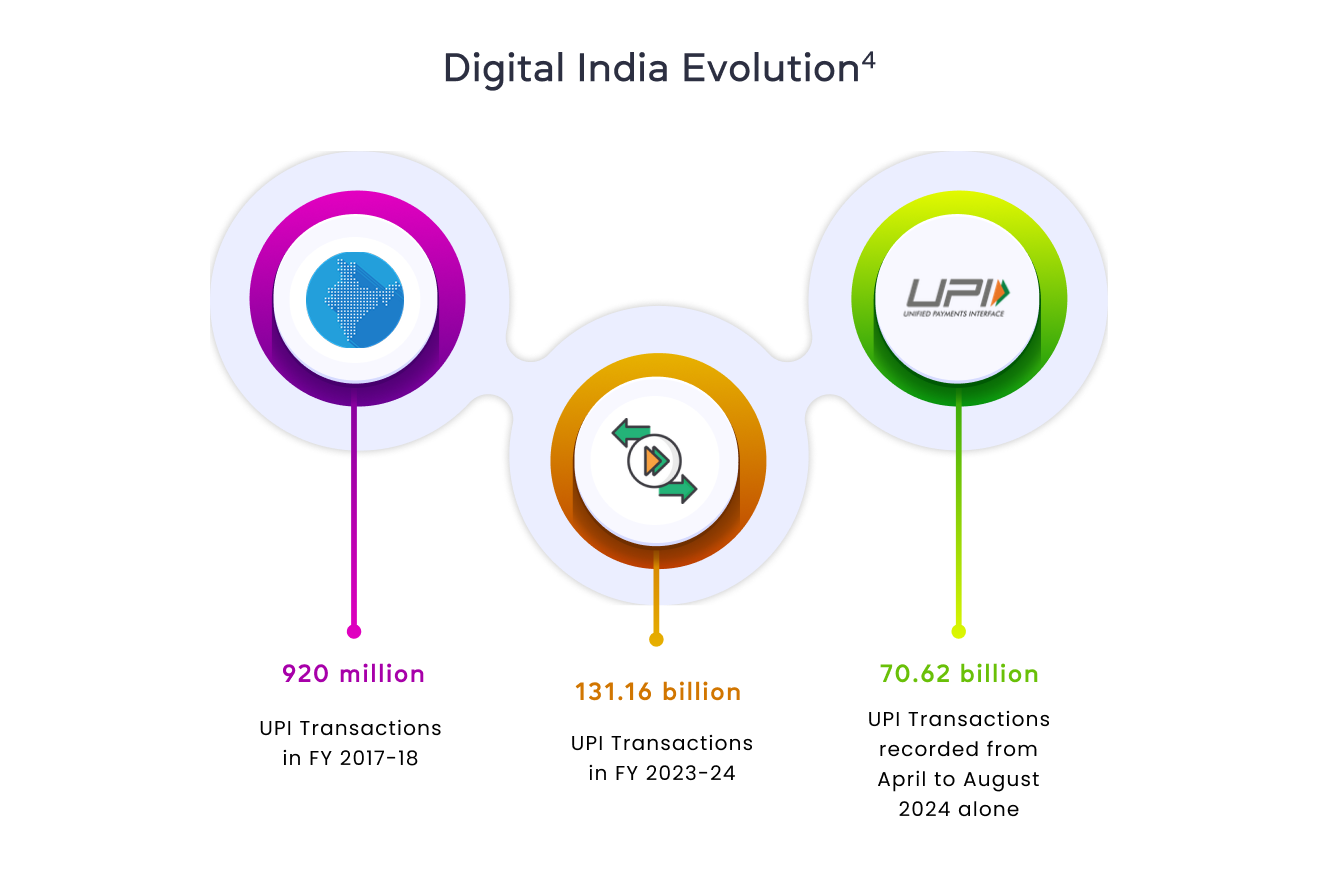
Online Food Delivery: This sector is revolutionizing the food industry by offering digital convenience and expanding consumer choice, contributing to better quality of life.
• CAGR of 13.26% expected between 2025-2030 resulting in a projected market volume of $54.97 billion in 2025 to $102.43 billion by 2030.5
• Grocery delivery to witness 22.1% revenue growth in 2026.5
FinTech Sector: India's FinTech industry is transforming the financial ecosystem through digital payments, online banking, and financial inclusion.
• UPI and digital lending platforms have become key enablers of the shift toward a cashless, inclusive economy. FinTech Market size was valued at $110 billion in 2024, and is expected to reach $420 billion by 2029, at a CAGR of 31% during the forecast period (2024-2029).6
• Payment volumes could hit $100 trillion with $50 billion in revenue by 2030.7
E-commerce: E-commerce platforms are reshaping how Indians shop, enhancing convenience and accessibility. This aligns with Digital India's vision of providing digital infrastructure and services on demand.
• With 944.7 million internet connections as of November 2024, the number of smartphone users has also grown dramatically, and is predicted to reach 1.1 billion by FY25.8
• The India E-Commerce Market size is estimated at $137.21 billion in 2025, and is expected to reach $363.30 billion by 2030, at a CAGR of 21.5% during the forecast period (2025-2030).9
• Online Festive sales in 2024 saw $14 billion Gross Merchandise Value (GMV), reflecting robust growth.10
Travel Market: Digital platforms for travel are simplifying how people plan and execute trips, reinforcing the initiative's aim of accessible digital services.
• The India Online Travel Market size is estimated at $19.05 billion in 2025, and is expected to reach $31.38 billion by 2030, growing at a CAGR of 10.5% during the forecast period (2025-2030).11
• Indian travel firms have seen a 25%-30% increase in bookings, for both air travel and accommodations, for Christmas and New Year holidays.11
• Mobile apps have become a significant channel for travel bookings, with many leading travel companies in India have developed user-friendly mobile apps, allowing travellers to book tickets and accommodations on the go.11
EdTech Sector: Edtech firms are making education more affordable and accessible, promoting universal digital literacy and skill development.
• India's education technology (EdTech) sector, a rapidly growing industry that has revolutionised traditional learning methods, is projected for significant growth. ·
• With an estimated current valuation of $7.5 billion in 2024, the sector is projected to expand at a CAGR of 25.8%, reaching an impulsive $29 billion by 2030, with over 100 million paid users.12

Digital India is more than a program — it's a movement that is shaping the future of the country. With continuous innovation, robust infrastructure, and inclusive policies, India is on the path to becoming a global digital powerhouse.
1. Digital India 2. Digital India 3. MyGOV 4. HSBC 5. Statista 6. ICICI Direct 7. Linearloop 8. IBEF 9. Mordor Intelligence 10. Financial Express 11. Mordor Intelligence 12. INVEST INDIA